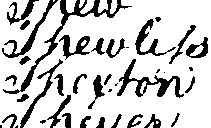
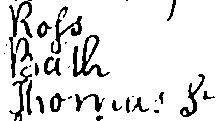
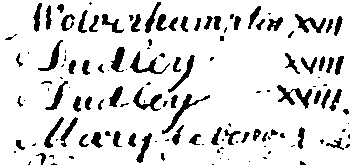
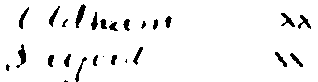
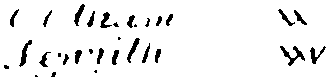
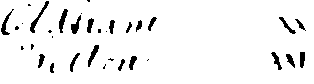
Many of the indexes being transcribed by FreeBMD from the earlier years are handwritten. Whilst
these indexes present special challenges to the transcriber, and take a little more effort than
the typed versions, they do represent the original index, and offer greater accuracy than typed
indexes.
This page seeks to offer advice on how to read the seemingly unreadable. The FreeBMD Project Team are
grateful to the John Slann Institute of Transcribing for permission to reproduce parts of this material.
Aids to Transcribers
A file containing
Districts sorted by Volume lists
Surnames list
can be obtained from
here The lists
are downloaded as a zipped file, about 1
Mb. The unzipped files are in text format and can be opened using a word-processor
such as Word or Notepad.
19th century writing
The pens used in the 19th Century were dip pens which had nibs shaped like a small
chisel. There was a small reservoir and ink travelled from the reservoir to the tip
of the nib by a split in the nib. Pressing hard on the pen caused the split to separate
and a broader line was drawn. The pen was normally held with the wide part of the nib
in a North-East to South-West orientation, more easily shown as
North-West to South East North-East to South-West
Any line drawn from North-West to South-East would be broad
Any line drawn from North-East to South-West would be thin
The pen could be moved with ease from North-East to South-West and vice versa
The pen could only be moved with ease from North-West to South-East
Movement from South-East to North-West was awkward
This explains why a character varies in thickness and there are variances from character to character
How the scans came about
The pages of the index were photographed and for many years the fiches produced from
the negatives have been used by genealogists. It is the digital scanning of these films
that we are transcribing. On some of the scans parts of letters are missing due to the
film and scanning process, similar to when photocopying a handwritten page. This effect
tends to be consistent and the bits missing are usually the thin bits of the characters.
Handwriting Styles
The handwriting varies slightly with different clerks who prepared the indexes. It seems that
each clerk did a run of consecutive pages so it is possible to get used to the individual styles.
In the example below;
We can see the way that 7 and 9 both had long legs.
Sometimes the long leg interferes with the number below.
What it doesn't show are the thick and thin lines!

 Reading the Writing
 North-East to South-West